

Creatine monohydrate: the most studied supplement and the myths around it
Creatine is the #1 supplement by volume of quality research — and one of the most myth-ridden. Let's set the record straight: how it works, how it's absorbed, and why it's the most 'cost-effective' supplement — per the ISSN position stand.
How creatine works
Creatine increases muscle phosphocreatine stores. During short, powerful efforts, phosphocreatine instantly resynthesizes ATP — the cell's main 'energy currency'. More phosphocreatine means more reps 'in the tank' and faster recovery between sets. The ISSN position stand calls creatine monohydrate the most effective supplement for increasing strength and muscle mass [1].
How creatine gets into muscle
Creatine is absorbed in the gut and delivered to muscle by a dedicated transporter (CreaT), and insulin enhances uptake — so taking it with carbs or food improves loading. The goal is to saturate muscle stores: you can do it faster via 'loading' (20 g/day for 5–7 days) or slower but equally effectively at 3–5 g/day. Monohydrate's water solubility makes a stick a convenient delivery [1][2].
Dosing made simple
A simple scheme works: 3–5 g of creatine monohydrate daily, consistently, without a mandatory 'loading' phase. The effect is cumulative and depends on store saturation — consistency matters more than exact timing. Monohydrate is the most studied and economical form; 'newer' forms don't outperform it [1][2].
Myths: kidneys, 'water' and 'chemistry'
The ISSN myth-busting is unequivocal [2]. Creatine is safe for healthy people with long-term use and doesn't harm the kidneys (it merely raises creatinine — a marker, not damage). It's not a 'steroid' or 'chemistry': creatine occurs naturally in meat and fish and is synthesized in the body. The small water retention happens inside muscle cells and improves their function — it's not 'bloating'.
Bonus: creatine and the brain
The brain is also energy-hungry. A systematic review of RCTs found creatine supplementation may improve some cognitive measures in healthy people, especially memory and under sleep deprivation [3]. So this 'strength' supplement works more broadly than it seems.
Why this isn't wasted money
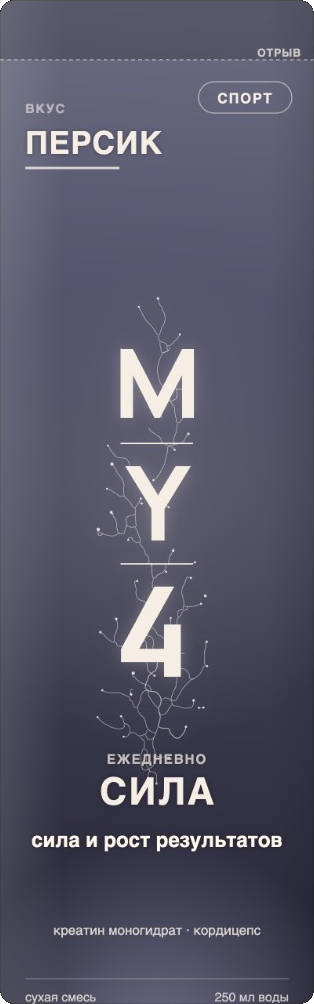
On 'evidence per dollar', creatine has no equal: hundreds of studies, a clear mechanism, a tiny daily dose. The key is taking it every day, not 'when you remember'. MY4 SPORT POWER solves exactly that: creatine in a convenient stick that's easy to make a daily habit.
MY4 SPORT POWER is creatine monohydrate with cordyceps in a convenient, sugar-free stick. One stick daily — a simple habit for strength progress without tubs of powder.
Power
Everything from this article — in one stick.
Try the formula →Hashtags
References
- [1]Kreider RB, et al. International Society of Sports Nutrition position stand: safety and efficacy of creatine supplementation in exercise, sport, and medicine. J Int Soc Sports Nutr. 2017;14:18.
- [2]Antonio J, et al. Common questions and misconceptions about creatine supplementation: what does the scientific evidence really show? J Int Soc Sports Nutr. 2021;18(1):13.
- [3]Avgerinos KI, et al. Effects of creatine supplementation on cognitive function of healthy individuals: a systematic review of randomized controlled trials. Exp Gerontol. 2018;108:166–173.
This material is informational and not medical advice. MY4 products are dietary supplements, not medicines. Consult a specialist before use; do not exceed the recommended dose.